Episode Transcript
[00:00:02] Speaker A: Take courage, my heart.
You've been too. Worse than this.
[00:00:06] Speaker B: You ready?
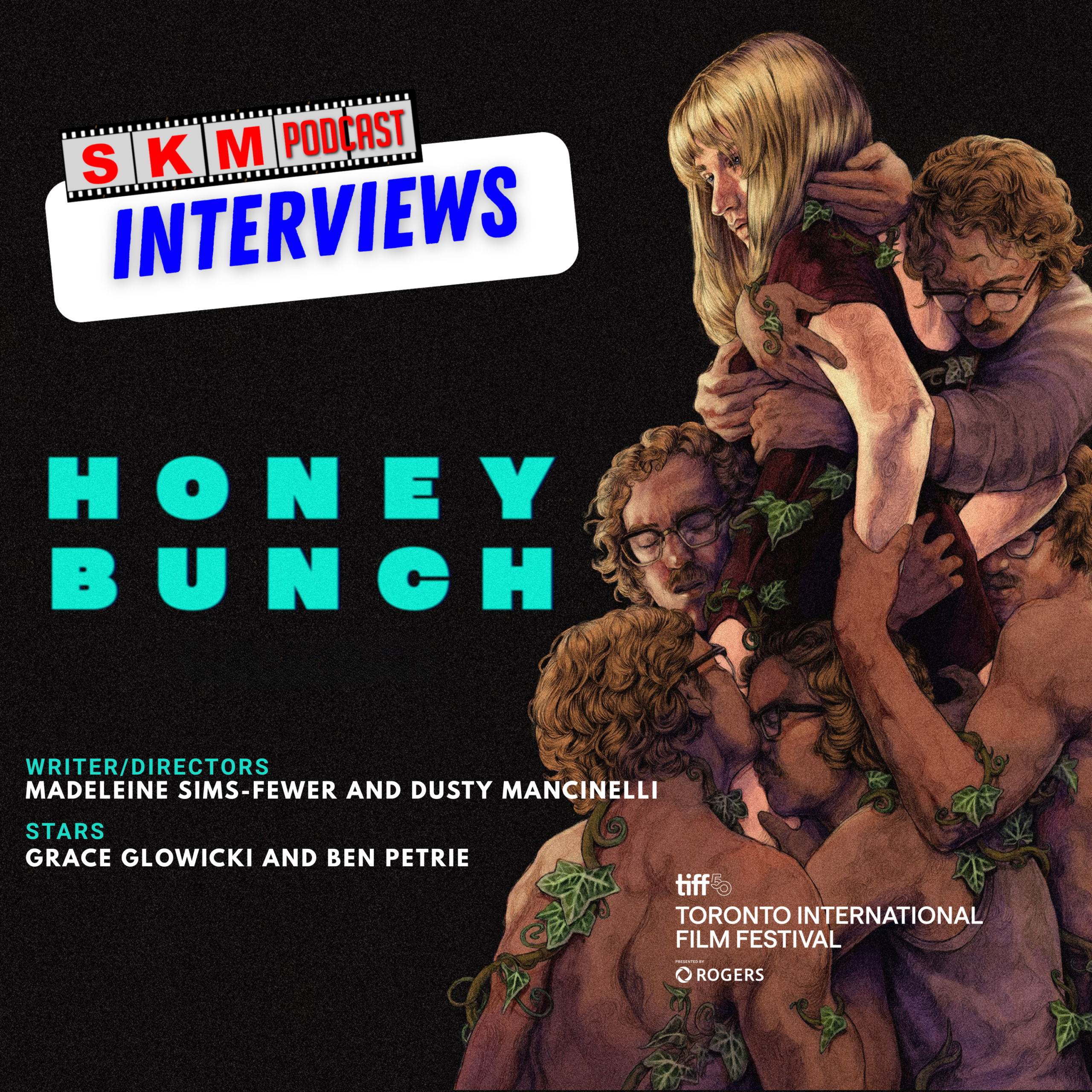
[00:00:07] Speaker C: Today on Sean Kelly Interviews, we're going behind the scenes of Honey Bunch in Canadian cinemas on January 23, 2026.
[00:00:14] Speaker D: We're gonna work together to get you better.
[00:00:17] Speaker B: Okay? Look at me now.
[00:00:18] Speaker C: Like. And subscribe for more content like this.
We start with the film's writer directors, Madeleine Sims. Fewer. And Dusty Mancinelli. Okay, so I'll start by asking how you got the idea for Honey Bunch.
[00:00:32] Speaker E: Great.
[00:00:32] Speaker A: Where did.
[00:00:33] Speaker E: Well, okay, so here's where it came from. It was Covid, and I was getting these heart palpitations and I had to go to the hospital, and turns out I have this, like, rare condition called supraventricular tachycardia. Yeah. And.
And so we got a little nervous. Well, you know, what. What happens if I die?
And, you know, Madeline was playing this game of, you know, asking me if she. If I would let her taxidermy my body. And I said, no, that's crazy and gross.
[00:01:06] Speaker B: I'm still working on it.
[00:01:07] Speaker E: And, you know, we made our first feature and it was really dark and challenging. It dealt with trauma, and we really wanted to do something that was completely the opposite. And at its heart, this is a twisted love story. And we've had long conversations about what does it mean to be in a long term committed relationship with someone who. And we were really trying to make something that rejected the notion that you have to find your true love. You're this compatible person. For us, we've discovered that love is like an ongoing process of renewal and commitment and having to fall back in love over and over if you want to make that relationship work.
[00:01:45] Speaker C: So that kind of leads into. My second question is, how would you describe Honey Bunch as different from A Violation, a film which I viewed as beautifully disturbing?
[00:01:54] Speaker E: Oh, good. Yeah. Well, hopefully it's a movie you want to watch more than once.
[00:01:57] Speaker B: Yeah, Yeah. I think it's.
How is it different? I mean, I think it shows a different side to us.
I think it shows a more playful side, a lighter side. It shows our musical taste.
[00:02:11] Speaker E: It does, Yeah. I mean, everything that we do hopefully will be different from the last thing. And it's just a natural evolution as we're trying to tell different stories.
But, yeah, really, I think everything about it is different. It's a completely different movie. And hopefully that is exciting and surprising for those who watch it.
[00:02:36] Speaker C: Could you talk about the casting of the film?
[00:02:39] Speaker E: Yeah, yeah.
[00:02:39] Speaker B: I mean, Ben and Grace, we. We basically wrote for. We wrote it for them. We saw Ben's film, her friend Adam with the two of them in many years ago and became friends with them. And then we loved Tito, where Grace's very physically transformative. And we knew Diana was going to physically transform in many ways in the film. And we knew that Homer had to be a nuanced character that you both love and hate and are suspicious of.
And we thought that both of them could encapsulate those characters really perfectly. So we started working with them when we were still writing the script.
And then the rest of the cast. Kate Dickey.
I saw the film Red Road when I was at theater school, and it was a huge influence on me as an actor. And then we've watched so much of her work and.
[00:03:32] Speaker E: And Julian Richings we were huge fans of, so we really wrote this for him. And we fell in love with India Brown on this TV show, Invasion, and she was just so amazing on it, so naturalistic.
And then Jason Isaacs was really sort of serendipitous. We were actually already filming and we hadn't been able to cast Joseph.
And he happened to be available and really connected with the material. And it was just an amazing privilege to be able to work with someone at that.
[00:04:02] Speaker B: Yeah, we never. He was always. He always kept coming up when we talked about the character, but we always would say, nah, he would. He's way too big. He would never do it.
And, yeah, really, luckily, he just really liked the script, and he has a daughter who's similar age to India, and it just. He was wonderful to work with.
[00:04:21] Speaker C: So what kind of. What genre would you describe Honey Bunch as? Because it's like a mix.
[00:04:28] Speaker E: It is a mix of things, and it's really hard to pinpoint it.
And that's sort of what's exciting to us about the movie, that it evolves with your experience watching it. You know, it presents itself as a Gothic thriller with a lot of mystery to it. And I think that's really.
If we had to, like, you know, fix it on one genre.
[00:04:49] Speaker B: A Gothic romantic horror is what I.
[00:04:52] Speaker E: Yeah, there we go.
[00:04:53] Speaker C: Yeah, I saw the news that Shudder picked up the film and they also got the violation a few years ago. So could you talk about your relationship with Shudder?
[00:05:02] Speaker E: Yeah, Shudder is amazing.
Emily Grotto there, Sam Zimmerman.
[00:05:09] Speaker A: They just really gotta.
[00:05:10] Speaker E: Gotta. They really understand the movie. You know, they really understand what we're trying to do with it. And they give us a lot of creative freedoms in trying to explore, you know, what's the best way to get this to audiences. And I think the platform Itself is really evolving. It's not just, you know, slasher films. It's not just horror, you know, it's really genre. And how can we expand that space? And I think that's really exciting to us.
[00:05:36] Speaker B: Yeah, I think horror used to mean something different in the 70s, which is how we approached this film as kind of filmmakers in that time making a film of that time. And, yeah, Sam and Emily just immediately understood that and were completely behind it.
[00:05:53] Speaker C: Well, one thing I liked about both Violation and Honey Bunch is that they kind of use their genre tropes to talk about deeper themes involving relationships and consent.
[00:06:04] Speaker E: Yeah, I think that's something that will naturally evolve in our work. We love genre films so much, so I think every film we do will have some element of that. And then we're always trying to make something that.
Where you can have a visceral experience as an audience, but then it lingers with you at the end, so it means something to everyone in a different way.
[00:06:24] Speaker B: Whenever we start making something too, it's always about what's pertinent, what's important to us in this moment. And then we construct the story around that first central question.
[00:06:36] Speaker C: Okay, thanks so much.
[00:06:37] Speaker B: Cool.
[00:06:37] Speaker E: Thank you so much.
[00:06:41] Speaker D: What if I have permanent brain damage?
[00:06:45] Speaker A: Then I'll take care of you, even.
[00:06:47] Speaker D: If I'm a vegetable.
[00:06:49] Speaker A: Especially if you're a vegetable.
I love you.
Pull.
Come on, then.
Pull faster.
[00:07:00] Speaker C: Up next, the stars of Honey Bunch, Grace Glowicky and Ben Petrie.
You became involved with this film.
[00:07:07] Speaker A: Well, I met Dusty and Madeline for the first time at Tiff, actually at a Tiff cocktail in, I think, 2016.
And then over the years, saw a number of their short films.
They were prolific short filmmakers before making Violation, and a lot of their shorts were great, and their craft always really, really impressed us.
So then one day they reached out to Grace and I and invited us over for dinner and cooked us a great meal and suppled us up with wine and then told us the story of Honey Bunch and kind of pitched it to us, walked us through the story and kind of put us in the audience seat of what the. How the movie would unfold. And we were pretty much hooked from the beginning.
[00:07:56] Speaker C: So how much of yourselves are in.
[00:07:58] Speaker A: The characters of Homer and Deanna?
[00:08:00] Speaker D: Good question.
I feel like. I feel like a lot of ourselves are in the characters because that's often just like the most helpful way to find yourself your way into a character. But the philosophies that the characters have about love, I would say that was something that we Needed to really consciously take from Dusty and Maddie and put.
Put on, like, a. Like a hat to them or goggles to, like, then look through.
So it's like a combination of, like, the parts of ourselves we could see in them and the parts in ourselves we had to step into.
[00:08:37] Speaker A: It's a fusion. It's a fusion of Dusty and Maddie.
[00:08:40] Speaker D: Yeah.
[00:08:41] Speaker C: So how. How are the characters different?
[00:08:44] Speaker A: Okay, how are the character. How is the character different?
Well, I could never grow that mustache.
Not even close. I had to.
They probably had to spend $80,000 in prosthetics and labor to make it look like I had a mustache.
Like, I could grow facial hair.
[00:09:04] Speaker D: Yeah. And speaking of hair, Diana's hair is, like, perfect compared to mine. That's, like, always all over the place. Like, she had this, like, pristine, beautiful, coughed, like, 70s dude that I just.
I personally would never know how to keep up.
[00:09:19] Speaker A: Like, the book ending scene of Film by the Ocean. How was it film that. Yeah, so the. The opening scene of the film and the closing scene of the film, we shot both of those on the first day of principal photography. And it was quite cold, but the whole crew and us were in the water together, shivering.
And then we ended up going back and shooting it again, like, six months later, once springtime came around, when it was a little bit warmer, I think, literally, because you could basically tell that I was freezing to death when we tried to shoot him in the first one. Not because the waters were actually dangerously cold in any way, just because I'm a fragile fellow.
So how is it acting alongside Jason Isaacs and Kate Dickey?
[00:10:11] Speaker D: They were awesome. We loved them both.
[00:10:14] Speaker A: Kate is the best.
[00:10:16] Speaker D: Kate is hilarious. And Jason is such a proud pro and so kind. So it was so cool for us to get to work with these. These actors that were a little bit older than us who have done so much more than us, and just getting to. To observe both of their different styles of working.
[00:10:32] Speaker A: And there was such.
[00:10:32] Speaker D: Such pros.
[00:10:33] Speaker A: Yeah. The professionalism and respect with which they treated. And they treated us so generously. Both of them. Yeah, both of them.
[00:10:40] Speaker D: It was amazing.
[00:10:42] Speaker A: Always associate Kate for Big Scottish Broke.
[00:10:45] Speaker D: Yeah, she's. I know her voice. It's amazing.
[00:10:48] Speaker C: Yeah.
[00:10:49] Speaker A: Oh, Grace, Grace, I love ya.
[00:10:56] Speaker C: So.
So without getting too specifics about the plot, which would you say is going.
[00:11:01] Speaker A: Through your character's heads?
[00:11:04] Speaker D: Oh, I think my character is very much like, constantly just trying to figure out what. What is going on around her. So she's constantly just, I think, tracking and trying to make sense of her environment.
[00:11:19] Speaker A: And I would say that Homer is just trying desperately to keep Diana feeling good.
She's trying a little too hard. Yeah.
So it's kind of like, in some.
[00:11:36] Speaker C: Ways, gaslighting, but they still very much love each other.
[00:11:43] Speaker D: Nailed it.
[00:11:49] Speaker A: So.
[00:11:57] Speaker C: So, as filmmakers yourselves, did you have any input in the directions of your characters?
[00:12:01] Speaker A: Yes. Yep. For sure. Yeah. I mean, ultimately, it always funneled through Dusty and Maddie's vision, but. But yes. Yeah. And they. They. Yeah. I mean, I would think back sometimes about how many questions they would be patient with, as I would kind of ask about.
I'm a control freak. I found it really hard to relinquish control and just be an actor. And they were very collaborative and patient with that process.
[00:12:35] Speaker D: Totally. Yeah. We had lots of ideas and they would take many of them. Listen to us. So they were super collaborative, but always end up. But they had a vision.
[00:12:45] Speaker A: Always funneled through their vision, and rightfully so.
[00:12:47] Speaker D: Yeah.
Okay.
[00:12:49] Speaker E: That's my question.
[00:12:50] Speaker D: Thank you so much.
[00:12:52] Speaker C: Things will be okay.
[00:12:53] Speaker A: Trust me.
[00:12:56] Speaker B: You're going to get better, Better, better, better, better.
You're going to get better.
[00:13:12] Speaker C: Sean Kelly on Movies Interviews is part of the SK on Movies podcast network. You can access links to all our shows by going to skonmoviespodcast, ca or search us on Spotify, Apple Podcasts, YouTube, or where else you listen to your podcasts. This has been a production of Sean Kelly on Movies Movies.