Episode Transcript
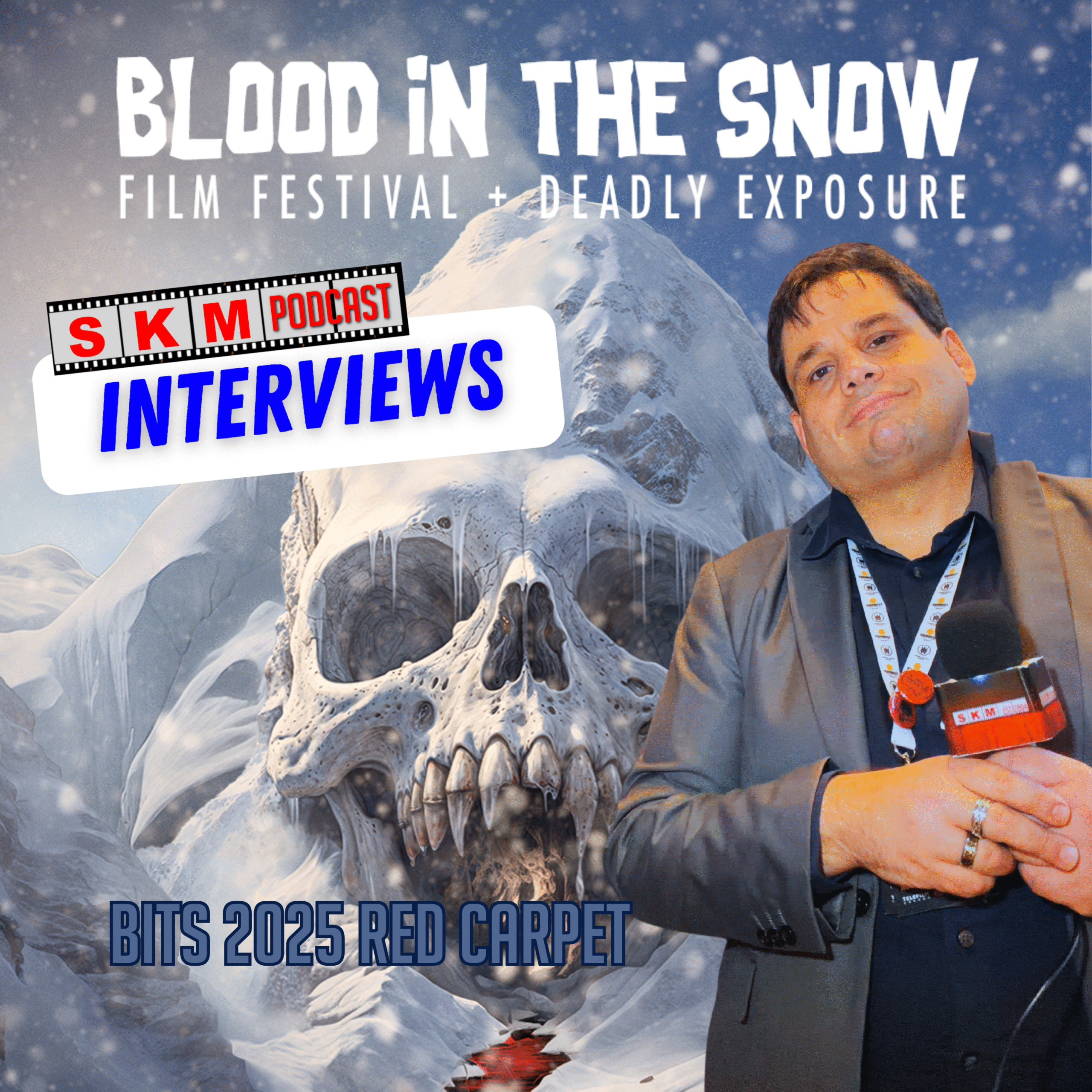
[00:00:08] Speaker A: Hello, this is Sean Kelly and I'm on the red carpet of the 2025 Blood and Snow Film Festival. First up is Andrew G. Cooper on Strangers. So what's your name and what film do you have this year?
[00:00:20] Speaker B: Yeah, my name is Andrew G. Cooper and I had a short film playing Bits. It's called Strangers.
[00:00:25] Speaker A: So can you talk a bit about the plot of the film?
[00:00:28] Speaker B: Yeah, it's about two people who are trapped in a basement while there's aliens prowling the streets outside.
The young male protagonist is trying to get back to a loved one during this time of crisis, essentially. And then in the end, there's a big scary alien puppet.
[00:00:48] Speaker A: Yeah, I thought the effects were actually quite good for the short.
[00:00:51] Speaker B: Oh, thank you. Yeah, yeah. I'm really into practical effects. So we built this huge puppet and we were trying to do something kind of cool and different with it. So thanks so much.
[00:01:00] Speaker A: And a lot of blue goo.
[00:01:02] Speaker B: Yes. Yeah, yeah, yeah. We had a lot of weird SFX stuff. Blue goo and the makeup and yeah, at one point it's like coming out of someone's mouth and, like in their eyes and stuff. So, yeah, it was a really fun project from that point of view, for sure.
[00:01:16] Speaker A: So what does it feel like playing at Blood and Snow?
[00:01:19] Speaker B: It was great. The audiences here are really fun. They're very vocal. I heard someone in the row near me, like, audibly gasp during a moment in my film. And, like, as a filmmaker, that's always fun. And people were chuckling at the part that I was like, this is the funny part. So, yeah, it's been great. It's a super fun festival.
[00:01:39] Speaker A: And you're actually part of Blood and Snow's new shorts program, Martians and Monsters, the Sci Fi program. So what does it feel to have that honor?
[00:01:49] Speaker B: I'm so excited. Kelly was talking about the festival programmer Kelly was talking about it, saying that he's been wanting to do this program for like a decade.
So being able to be part of the inaugural program was very, very cool. And as a filmmaker, it was also just really neat seeing all the other sort of monsters and Martians that were programmed in the same shorts block. I was thrilled. As a monster lover, like, I made a monster short film, so I love monsters. It was really cool to come out and just see what other people are doing and to take it in. It was a blast.
[00:02:21] Speaker A: All right, thanks. Here is Prasanna Paul and Gavin Downs on Santorum.
[00:02:27] Speaker C: My name is Prasanna Paul. I'm the director, writer and producer of Santorum and also the vfx.
[00:02:35] Speaker B: I'm Gavin Downs. I'm a producer and lead actor in the film Sanctorum.
[00:02:39] Speaker A: So talk a bit about the plot of the film.
[00:02:42] Speaker C: So Santorum is about happens in this rugged post apocalyptic world where this former engineer who's sort of losing his mind and with whatever knowledge he has left, building an AI robot to fight another entity that's out there. And that's the huge premise of it. And this movie we rewarded as a feature.
And the short is more of a pitch package. That's how we structured it.
[00:03:08] Speaker B: Yeah.
[00:03:09] Speaker A: So I remember the short having some impressive visual effects to it.
[00:03:12] Speaker C: Oh, yeah. I mean, a lot. We shot this movie in 2020 and it took us like five years to complete it.
There's a lot of VFX, there's a lot of learning curves right throughout the process. I gotta redo a lot of things, relearn a lot of things, so. And look, 80% of the movie shot in front of a green screen.
[00:03:29] Speaker D: Yeah, right.
[00:03:30] Speaker C: And without any dialogue. So it's visually driven, but yeah.
[00:03:36] Speaker A: So what does it feel like playing in this is Sci Fi program?
[00:03:40] Speaker C: It is great. You know, like, I. I've been following these guys for years and I do visual effects.
So a lot of my movies that I did VFX on played in the festival, but to have one of my own to play in the festival is a huge deal.
[00:03:54] Speaker A: Okay, great, thanks.
[00:03:57] Speaker C: I never want to add something.
[00:04:00] Speaker B: No, I'm just. I love seeing how far Blood in the Snow has come. Kelly's a good friend of mine and I'm super happy for them and very honored to be a part of the first ever Sci Fi segment of their festival. So that's a lot of fun and just glad to be here celebrating with Persona. And our team put a lot of hard work into it, so I'm glad to see it be able to be screened for the public.
[00:04:22] Speaker A: All right, thanks. Next is Shelly Findlay on Donations.
[00:04:25] Speaker E: My name is Shelley Findlay. I am the director of Donations.
[00:04:30] Speaker A: So could you talk a bit about what the film is about?
[00:04:33] Speaker B: Yes.
[00:04:33] Speaker E: So Donations is a not too distant dystopian world where in order to access our smartphones, we have to donate blood into the phone. The world economic system has collapsed and we've now we're using a bio currency which is blood. And we focus on one fellow in particular named JC who is trying to check in on his ex girlfriend and he is forced to donate a serious amount of blood in order to creep her social media feed.
[00:05:09] Speaker A: So I kind of interpreted this short as being about our increasing addiction to technology.
[00:05:15] Speaker E: Absolutely. So we do have a parallel within the film of other addictions.
But really, at the end of the day, we also wanted to focus on the human aspect of it, of a guy who just, you know, he's lost the love of his life and, you know, and then there's a whole layer of technology on top of that.
[00:05:37] Speaker A: Yeah. I think one of the major plot points in the short is the guy trying to figure out how to circumvent the limitations of giving too much of your glucose.
[00:05:48] Speaker E: Exactly. There is a black market that emerges in this world, you know, similar to what happens in. In our own world.
So he's found a way around it, much to his own detriment. I don't want to give too much away, but yes.
[00:06:07] Speaker A: So you played as part of the Dark Visions program. So that's what's more restrictively horror program at this. So what are your thoughts on this being a horror short?
[00:06:19] Speaker E: Well, we were very flattered to be included in the Dark Visions program.
I think it's more psychologically horrific, more. So there's no, you know, even though there's blood involved, it's not overly graphic, I guess you could say. So we wanted to focus more on the psychological terror of what would happen in this situation.
[00:06:46] Speaker A: Here's Juan Francesco Calero on Petite Demons.
[00:06:50] Speaker F: Oh, my name is Juan Francisco Calero. I'm a writer and director of Petite Demons that have been selected here in Beats.
I've been a fan of Beats for a long time, so super grateful to begin.
[00:07:06] Speaker A: So Petite Demons played as part of the Bits and Bytes series. Go. So could you talk a bit more about it?
[00:07:12] Speaker F: Yes, that section is for Work Seria. Petite Demos is Work Seria. We just released the pilots.
We have finished part of the second episode, but more is coming. Yeah.
[00:07:28] Speaker A: So I thought that it had a kind of like a bit of a graphic novel feel to it.
[00:07:32] Speaker F: You are completely right. Yeah. My reference, even aesthetically, as it's been some graphic novel, that they are very, very gritty, like the original Ninja Turtles, you know, that was. The line was super dark around there and that. And a part of the format, 5 minutes is not because we didn't have more money or we were lazy. It's the time it takes more or less to read a comic book issue of Single One Single. So five minutes is kind of the experiment. Let's see if we can get that spirit when you read a graphic novel.
[00:08:06] Speaker A: Now, the first episode doesn't really explain it. Why are the demons Petite?
[00:08:10] Speaker F: Oh, yeah.
Yeah, the thing is that the information is very condensed, I'm afraid, so you have to see it several times. But, yeah, it's petitimos, as she says, it's because her captor call the portion that she. That he was feeling for abusing her because the petty demons make him do it.
But no, it doesn't have to be petty demons, but she still visualize them as petty demons.
[00:08:47] Speaker A: All right, thanks.
[00:08:48] Speaker B: Thank you.
[00:08:49] Speaker A: Here's Lulu Lu and Darcy Quinn McGimcy on cherry on Top.
[00:08:55] Speaker G: I'm Lulu. I'm the director of Cherry on Top.
[00:08:57] Speaker E: And I'm Darcy. I'm the writer and producer of Cherry on Top.
[00:09:01] Speaker A: So what inspired you to make this film?
[00:09:04] Speaker E: Okay, so when we first started thinking about this film, it was actually during COVID so we were thinking, what can we film with the restrictions, with a limited crew and a limited cast? We ended up developing it a little bit later. But during COVID we asked ourselves a lot of questions, like, what would it be like growing up during those restrictions being, I guess, coming of age during that time? And we pulled a lot of inspiration from our own experiences with girlhood, the things that influenced us, like Teeny Bopper magazines, for example.
And then we looked at other themes related to femininity. So we used the lens of religion to explore, like, purity and restraint and then something. If you want to talk about the Monstrous Feminine.
[00:09:44] Speaker A: Yeah.
[00:09:45] Speaker G: And we. We kind of looked into a lot of horror films inspiring this movie and came across this genre called the Monstrous Feminine, which is, like, there's a lot of horror movies about, like, the women's bodies going under stages that people are not familiar with. So, like, pregnancies and puberty is often, like, a central point for horror. So really looking into that and just like, yeah, policing female bodies and, like, changing female bodies, kind of seeing what that's like.
[00:10:11] Speaker A: Well, like, I found that the plot is pretty much like the conflict between religion and sexuality. And then the kind of girls, like, have their own interpretation of BDSM practices. So could you maybe talk a bit about that?
[00:10:30] Speaker G: Yeah, I think that in the film, very much. We wanted the magazines to be their biblical text and make that very clear, as it was for us at the time.
[00:10:39] Speaker B: Time.
[00:10:39] Speaker G: And there was something very satirical, I think, and also looking back to our childhood of, like, oh, my gosh, what is bdsm? And kind of, like, maybe peaking it and not trying to understand it fully and having these, like, really poor understandings of it, just because, I guess sexual education is not that readily available.
So there was something really fun about poking. Poking into that and kind of. Yeah, like seeing these like little, little advances that girls are trying to make towards, like blossoming into their adulthood, but, you know, not quite getting it, I find really fun.
[00:11:11] Speaker E: What about yourself?
[00:11:12] Speaker G: Yeah, I think there's a lot of.
[00:11:13] Speaker E: Interesting parallels between religion and eroticism, especially like bdsm. In the actual quiz, we talked about concepts of like, dominance and submission. And I think that's very prevalent in any systems of power, so religion being one of them.
[00:11:28] Speaker A: So this play is part of the Fuddy Frights program.
Do you consider this to be a comedy?
[00:11:36] Speaker G: Yeah, I would think so. I would think so. And like, we were talking about this yesterday after playing the entire program consistently. I think from our screenings, we were always a little bit apprehensive. Like, you know, obviously it goes. It's kind of out there in terms of what it's trying to tackle and like the senses of humor that was trying to tap into. But it really was a good home for it and we saw some really, like even more outlandish things yesterday. So, yeah, it was a really nice kind of home for it, for sure.
[00:12:08] Speaker E: Yeah. The program itself was so well curated.
It was interesting seeing these different interpretations of horror, seeing what was similar with our film and the other programs, and then also how it very vastly varied from short film to short film.
[00:12:23] Speaker A: Great, thanks. Next is Zach Green on Cancer Season.
[00:12:27] Speaker B: My name is Zach Green Green and I have a film called Cancer Season that's playing above in the snow. It's a Toronto premiere.
[00:12:34] Speaker A: Yeah. And I watched the film and I was actually. I thought it was like cancer, cancer, but it was actually cancer horoscope.
[00:12:41] Speaker B: Yeah, no, it definitely is a bit of a. I don't know, you gotta watch the movie to find out that it's about astrology. But yeah, it's about a witch who is a cancer who has a kind of suffocating obsession with her old best friend and ties herself to her bed one night and casts a body swapping spell on the friend's new partner so she can be in this relationship for the day. And it's called Cancer Season because I was using astrology to introspect and do shadow work and look at my past of missteps and romance and where I can be obsessive and water signs or famously very emotional and.
[00:13:24] Speaker A: Yeah, yeah, so you're playing in the. The Emerging Screams program. So what does it feel to be part of these up and coming filmmakers?
[00:13:32] Speaker B: It's exciting.
[00:13:33] Speaker F: Yeah.
[00:13:34] Speaker B: It's like my first funded short and definitely is like I was hoping for it to be like, kind of a calling card for my style now that I'm done, and I'm like, I don't know. I'm always going to be wanting to develop my style in new ways, but it's. It's really exciting. It's. I'm excited to see the films of my peers as well. And, yeah, it's. Has been a great. A great time so far, so.
[00:13:57] Speaker A: Yeah, I didn't know. It's like, it was like a. Like a visual style, like photo negative kind of.
[00:14:01] Speaker B: Yeah, no, I had a lot of fun in the edit, just playing with this specific red negative look where it wasn't in the script. And then I realized I could kind of match on action with, you know, these kind of images of Paddy fantasizing about being with Elaine. And then me and my colorist got super into it and, yeah, the color is, I'd say, one of the more standout parts of the film. Got pretty obsessive over that.
[00:14:28] Speaker E: All right, thanks.
[00:14:29] Speaker A: Next up, I talk with Blood and Snow Festival director and founder Kelly Michael Stewart. All right, so Blood and Snow Festival director and founder Kelly Michael Stewart.
[00:14:39] Speaker H: Hey, Sean.
[00:14:39] Speaker A: Hello.
Well, we've known each other for pretty much the entire distance of the festival.
[00:14:44] Speaker B: I think so.
[00:14:45] Speaker H: Yeah. Probably from year one or two.
[00:14:47] Speaker A: Yeah, Year two.
[00:14:47] Speaker B: Year two.
[00:14:48] Speaker H: Okay.
[00:14:48] Speaker A: There you go.
[00:14:49] Speaker H: Yeah. Yeah, I'm excited to be here. I'm excited to see you here too.
[00:14:53] Speaker D: Yeah.
[00:14:54] Speaker A: So let us know. Has actually grown quite a bit over the last few years. So what are your comments on that?
[00:15:02] Speaker H: Yeah, it's amazing.
We don't know the exact numbers yet, but it's like grown by at least 15% so far. But also just the vibes of it. It's really been great. And it's been really crowds both for the industry conference and for the screenings. And I'm not really sure why. I think a reputation, other than maybe our reputation's been growing, and I think there's a lot of elbows up as well. That's kind of helping encourage people to see Canadian content right now. But. But overall, I just think we've always had sustainable growth right from very first year, and I think it just keeps happening and. And it's. It's pretty wonderful what we've all created.
[00:15:35] Speaker A: Well, by my observation, the turning point was when you went to Super Channel during the pandemic.
[00:15:40] Speaker H: That's a very accurate observation. Yeah, they were a big help for us during the pandemic. We were the few organizations that did quite well in the sense that we Were on Super channel for 2020, and then we did Hybrid in 21 and 22, and that really kind of put us in a new level. We were able to move to this big theater, the Isabel Bader Theater. And they stayed with us for five years, so we really appreciated it.
[00:16:02] Speaker A: Yeah, I noticed that they were not on the sponsorship this year. Yeah.
[00:16:05] Speaker H: But all good things come to an end, and we're really good. There were actually still guests in our roundtables this year. And, you know, so they're. They're still friends of ours and stuff like that. And we had a wonderful five year. I was expecting one year. We got five years into that, so we're really. We're really great friends with them.
[00:16:21] Speaker A: So what were some of the big sellers this year?
[00:16:24] Speaker H: Nash the Slash. We're about to have that premiere right now, and I think it will be pretty much rush line for that. We'll see how that goes. And it's been amazing. So we've got that. That's been a big, big one. Our opening film, Son of Sarah, was a really big one.
And surprisingly, or not surprisingly, some of our shorts programs have really blown up. Our Funny Frights and Unusual Sites was our biggest seller we've ever had up to this national slash screening. So it's pretty incredible to see such an audience build for that. And so it's interesting to see.
[00:16:53] Speaker D: I think a lot more people are.
[00:16:53] Speaker H: Watching short films than they did pre Pandemic. So it's seen a new trend that's happening in cinema.
[00:17:00] Speaker A: Okay. Okay, thank you.
Finally, here is Tim Kowalski and Kevin Byrne on Nash the Slash Rises Again. Nash the Slash Strikes Again. So what inspired you to make this documentary?
[00:17:13] Speaker D: Well, look at pictures of him. What do you think?
Yeah, I mean, it's intriguing, you know, just from a visual perspective, but as soon as you start to, like, unwrap a little bit, you realize, like, there's an incredible human story behind it.
[00:17:28] Speaker B: Absolutely.
[00:17:29] Speaker A: And pun intended.
[00:17:31] Speaker D: Absolutely. We had Death by a Thousand Cuts, you know, cutting Edge, Unwrapped, you know, all that stuff.
[00:17:37] Speaker B: We're gonna do it all. All night Long.
[00:17:40] Speaker A: So could you talk about the cultural impact of Nash to Slash?
[00:17:49] Speaker D: The cultural impact of Nash to Slash? That's. That's a loaded question, actually, because he was a really niche performer in his time, and even when he was at the height of his powers, he still was a very polarizing figure.
[00:18:05] Speaker B: Right.
[00:18:06] Speaker D: So the people that do remember him remember him very fondly and are super passionate fans, but there was also a lot of people that didn't get him. And so those people just wrote him off as like a novelty or a joke.
So we're hoping to right those wrongs because we feel that he did really interesting pioneering work. He started doing electronic music as a one man band in the 70s. Nobody was doing that. And he was also a fascinating character. So behind the bandages there's a great story to be told.
[00:18:42] Speaker A: Well, one interesting thing that I took away from the documentary is how his collaborations with Bruce McDonald for the early films, including appearing in Roadkill, that I did not know.
[00:18:54] Speaker D: Oh, yeah, yeah. He's like, he was a really good friend with our executive producer, Colin Brunton, who also produced those early McDonald films. And so when they were doing a bar scene, was it. Did somebody cancel a Nashville in at the last second?
[00:19:13] Speaker B: That's the story.
[00:19:14] Speaker F: Yeah, yeah.
[00:19:14] Speaker D: I can't remember who was supposed to be in that film, but, you know, clearly Nash was the right person for the, for that job.
[00:19:20] Speaker A: Yeah, the cliff in the film of like Don McKellar, like saying, this is violence and you like it. Yeah, exactly.
[00:19:29] Speaker B: Yeah.
[00:19:30] Speaker D: That must have been written on the spot because I don't think Nash was in the script originally. But man, oh man, what a great sound bite. And he put it to excellent use, so. Yeah, yeah.
[00:19:41] Speaker E: And.
[00:19:44] Speaker A: Featuring Gary Newman and Nikki Pop in the film as well.
[00:19:47] Speaker D: Oh, yeah, well, you know, he. We were just like, just doing an interview a minute ago. We were talking about how he attracted really interesting, fascinating people and yeah, Iggy Pop, Gary Newman are among them, you know, and why not? I mean, look, look at, look at what he did and how he did it and he kind of made his own mark. And I think guys like Iggy and Gary respect that. Yeah, like, it's one of those things where, you know, like, real innovation recognizes innovation, you know, in their time, you know, Gary Newman at the, at the sort of forefront of electronic music and.
[00:20:26] Speaker B: It'S, you know, it's, you know, ascendance into the mainstream.
[00:20:29] Speaker D: And then you have Iggy Pop, who, you know, the Stooges is like one of those bands that influence almost a billion other bands. So when those kinds of, you know, iconic artists recognize Nash and could see in him something unique, you gotta, you know, that's a story that's worth telling as a Canadian story that we don't tell as much as we should.
[00:20:49] Speaker E: Right, yeah.
[00:20:51] Speaker A: So.
Well, Nash was based in Toronto. So how does it feel screening the film in Toronto?
[00:20:58] Speaker D: I think. Well, actually it's funny because the North.
[00:21:01] Speaker B: American premiere is here in Toronto.
[00:21:03] Speaker D: The world premiere was in London. England, like a couple, three weeks ago, something like that.
And, you know, he, he made a mark there in the early 80s.
But it feels good to do it here because there's so much of his his personal friends, his family, you know, people he made connections with throughout his life are all going to come out tonight. So it does feel like a really special time.
[00:21:30] Speaker A: Okay, well, congratulations on the North American premiere of Nashla Slash Rides Again, Rises Again, Rises Again, Just like a loaf of bread.
Okay, thanks.
Sean Kelly on Movies Interviews is part of the SK on Movies podcast network. You can access links to all our shows by going to skonmoviespodcast, ca or search us on Spotify, Apple Podcasts, YouTube, YouTube, or where else you listen to your podcasts. This has been a production of Sean Kelly on Movies.